From Access to Intelligence: What We Came to See
- Our wish list was ambitious:
Visit Huawei’s R&D centers for AI, cybersecurity, and 50G PON - Discuss compliance with European telecom regulation
- See real-world 5G/6G innovation and smart city deployments
- Explore factory operations and in-building fiber solutions
- Test-drive smart vehicles and experience digital twin solutions
- Understand how China keeps 22 million connections online
- And of course… explore the buzzing tech markets of Shenzhen
By Andrew van der Haar Founder & Managing Director, Fiber Carrier Association President, European Local Fibre Alliance
Thanks to Huawei and an incredibly dedicated team of guides and planners, we got to experience it all and more.

Want to gain access to all presentations?
Simply send Andrew an email and request access. You will be provided with the password that allows you full access to all 8 presentations.
Innovation, Scaled
Shenzhen’s Huawei campus alone is a testament to China’s scale. Spanning several square kilometers, it’s not just an office, it’s a city of technology. From the Darwin exhibition hall to the flagship stores, we experienced first-hand how ideas move rapidly from lab to market. What was clear that big investments in R&D are a driving force of all those innovations.
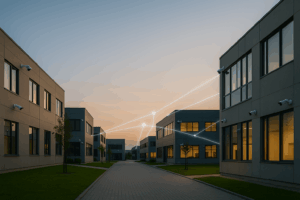
We were especially impressed by the Dongguan campus, a workplace modeled after various European cities, combining architectural charm with technical ambition.
More than just symbolic, it shows how Huawei invests in people. R&D thrives where people are inspired, and it was clear this environment contributes to world-class innovation.
Shenzhen's Electronic Pulse
No visit to China’s tech epicenter would be complete without a stop at the legendary Shenzhen Electronic Mall’s. For many in the group, this was a chance to see the grassroots engine of innovation, a sprawling complex of components, devices, prototypes, gadgets, and creative ideas. It was overwhelming in the best sense: chaotic, creative, and buzzing with entrepreneurial energy.
It’s here that you witness the ecosystem at work. Where hardware startups are born, where components for tomorrow’s innovations are already being traded today. For those working in infrastructure or AI, it offered a different, complementary view of the digital value chain: from microchips to megaprojects. What you see on AliExpress or other platforms, in these malls is the real deal.
Behind the Factory Doors: AI Supporting Human Excellence
One of the most eye-opening moments came during our visit to one of Huawei’s high-tech factories. Normally, these places are closed to outsiders, but we were granted access to witness firsthand how AI is woven into every step of the production line. Storage of equipment is fully robotized.
Rather than replacing people, AI acts as a co-pilot. It helps to validate if every component is assembled correctly, dramatically reducing future failures and improving quality. Equally impressive was how employees are encouraged to express their emotional state at the start of each shift. By sharing how they feel, co-workers can offer support and help ensure a more attentive, compassionate environment, something you rarely hear about in high-performance manufacturing.
Shanghai: A City of 22 million, Seamlessly Connected
Our visit to the headquarters of China Telecom in Shanghai brought another perspective: scale and simplicity. With over 22 million people connected in one metro area, the infrastructure demands are immense, but the user experience is surprisingly smooth.
We saw live demonstrations of added-value consumer services:
- Private cloud and data storage for households
- Smart home integration (security, energy, automation)
- Seamless customer service and onboarding tools
Yes, similar services exist in Europe, but what stood out was how China Telecom combines infrastructure, support, and usability into a single customer journey. No need for technical knowledge or DIY setup; the service is packaged, explained, and supported.
Perhaps even more surprising: privacy, security, and compliance were clearly addressed. Where Western narratives often suggest the opposite, our visit showed an operator that is not only technically advanced but also well aware of GDPR-style concerns — and actively designing around them.

AI + Fiber: A New Digital Value Chain
One of the strongest takeaways from this trip was the convergence of fiber and AI. In Huawei’s closed-door sessions, we explored how telecom networks are being reconstructed around artificial intelligence.
AI doesn’t just improve customer service. It’s redesigning operations. Whether it’s predictive maintenance of fiber networks, generative AI for customer support, or digital twins for SLA optimization, the impact is profound. By 2033, over 60% of network traffic will be AI-driven, according to Omdia.
Huawei’s AI-integrated solutions such as DeepSeek, FaultSpirit, and AssurSpirit. This showcased how fiber networks are no longer passive infrastructure. They’re intelligent, self-optimizing systems that reduce downtime, cut costs, and deliver new services across industries.
The Human Factor
What made this trip so successful wasn’t just the access to innovation, it was the people. Across Shenzhen, Dongguan, Hangzhou, Shanghai, and Beijing, we were welcomed warmly, challenged intellectually, and inspired repeatedly.
We discussed how FTTR (Fiber to the Room) can enhance in-building performance. We debated B2B potential with FTTO (Fiber to the Office) solutions. And we exchanged ideas on regulation, infrastructure strategy, and Europe’s unique challenges with Chinese counterparts.
Cultural Richness and Lasting Bonds
Beyond the tech, China’s cultural depth also left a mark. From historical sites to high-speed trains, the country’s duality of heritage and hypermodernity was on full display. It reminded us that digital transformation is not just about cables and code, but about people, culture, and shared understanding.
And as much as this was a study mission, it was also a human journey. Traveling together, sharing meals, asking hard questions, exploring unfamiliar places, these things create bonds. Not just between delegates, but between organizations and nations. In an increasingly digital and globalized world, trust and relationships matter more than ever.
Looking Ahead
This mission was only the beginning. With so many learnings and new relationships, it’s clear that cross-border dialogue is more important than ever, not just to stay competitive, but to shape a fair, open, and intelligent digital future.
On behalf of the Fiber Carrier Association and the European Local Fibre Alliance, I want to thank Huawei, China Telecom, our fellow travelers, and all our partners for making this journey possible.
The fiber future is not just fast it’s smart. And it’s already happening.